
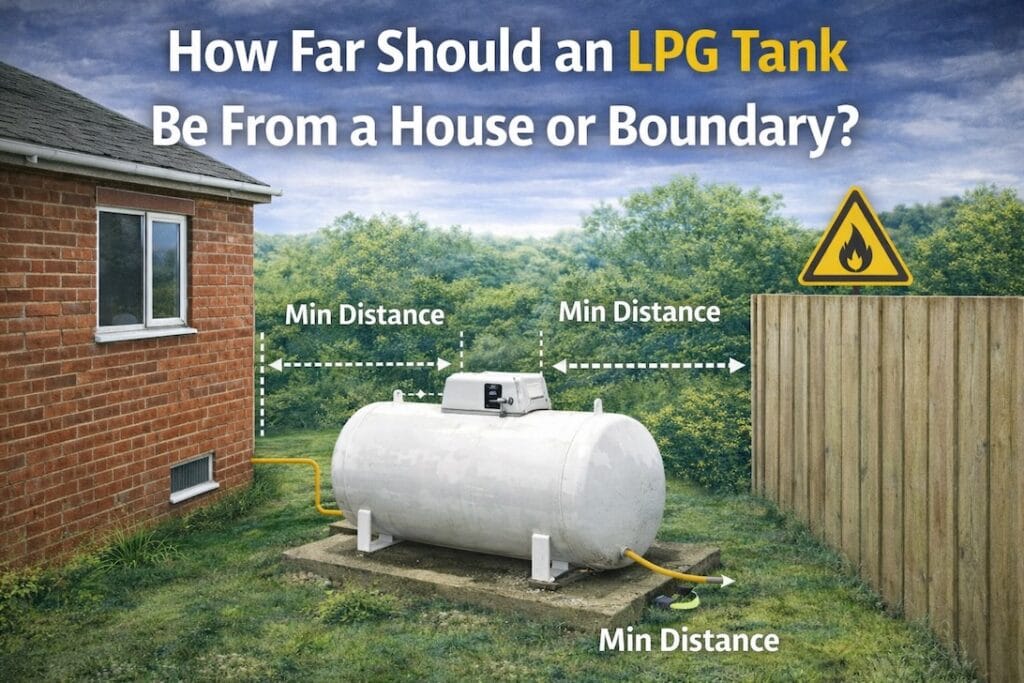
How Far Should an LPG Tank Be From a House or Boundary?
If you are planning a new installation or reviewing an existing setup, it is sensible to ask about the LPG tank distance from house requirements. LPG tanks cannot simply be placed wherever there is spare room. They need to be positioned with safety in mind, taking account of nearby buildings, boundaries, openings, drains and possible ignition sources.
In the UK, domestic bulk LPG tanks are subject to siting guidance and minimum separation distances. The exact distance depends on the type and size of the tank and the layout of the property, so there is no single measurement that applies to every home. The tank supplier should be able to confirm what is required for your particular installation.
This guide explains why those distances matter, what general siting issues are considered and why a proper site check is so important before any installation or switch goes ahead.
Why distances matter
The reason LPG tanks need clear separation distances is safety. There should be a minimum distance between the tank and any building, boundary line or fixed source of ignition. These spaces help reduce risk and make sure the tank is installed in a location that remains safe in everyday use.
Distance also matters because LPG is heavier than air. If gas were to escape, it can collect in low areas rather than dispersing upwards quickly. That is why drains, gullies, cellars and similar features are part of the siting assessment, not just the wall of the house itself.
General siting considerations
When assessing where a tank can go, installers do not just measure to the nearest wall and stop there. They look at the wider surroundings of the proposed location.
General factors often include:
- distance from the house and other buildings
- distance from the boundary line
- access for deliveries and maintenance
- nearby drains, gullies or low-level openings
- proximity to sources of ignition or electrical equipment
- whether the area is clear, ventilated and easy to keep maintained
In practice, this means the best position for a tank is often one that balances safety clearances, delivery access and the day-to-day layout of the property, rather than simply the most hidden or convenient corner of the garden.
Boundaries, buildings, openings and ignition risks
Many homeowners specifically ask about the LPG tank distance from fence or boundary. That is a sensible concern, because boundaries and nearby structures form part of the required separation distance.
It is also important to think about openings in the building, not just the outside wall. Open windows, air bricks, vents, ducts and cellar openings can all affect whether a proposed location is suitable. Low-level openings matter in particular because escaping LPG vapour can travel and settle.
Ignition risk is another key issue. The required separation space is not only about buildings and boundaries but also about fixed ignition sources. That is why installers will consider things like electrical equipment, flues and other potential hazards near the proposed tank position.
Because every garden and property layout is different, the practical answer is not just “how far from the house?” but “how far from all nearby risks combined?”. That is why published rules are used alongside a site-specific assessment.
Why a site check matters
A site check matters because two homes with similar-looking gardens can still have very different siting outcomes. One may have enough separation from the house, boundary and openings, while another may have access issues, drains in the wrong place or nearby features that make the first-choice position unsuitable.
The final decision should be based on the actual site and the applicable LPG siting guidance, not guesswork.
A proper check is especially useful if:
- you are installing a new tank
- you are switching supplier and want to know if the existing position is acceptable
- the property has changed since the tank was installed
- you are planning nearby fencing, sheds, landscaping or building works
If anything has changed around the tank area, it is worth raising it before work begins. A small garden alteration can sometimes affect the clearances around the tank more than people realise.
Do not rely on a rough guess
There is no single universal figure that answers every LPG tank siting rules question. The safe distance depends on the tank type, tank size and the details of the site. What matters is that the installation meets the relevant siting guidance for that specific property and that the supplier confirms the correct separation distance.
If you are unsure whether your current tank position is acceptable, or whether a new location is suitable, it is best to have it checked properly rather than relying on a rough estimate from the edge of a patio or fence line.
Need help comparing LPG options?
If you are planning a new LPG setup or reviewing your current arrangement, getting local advice and comparing supply options is a sensible next step.
Check local LPG quotes in your area and see what options may be available for your property.