
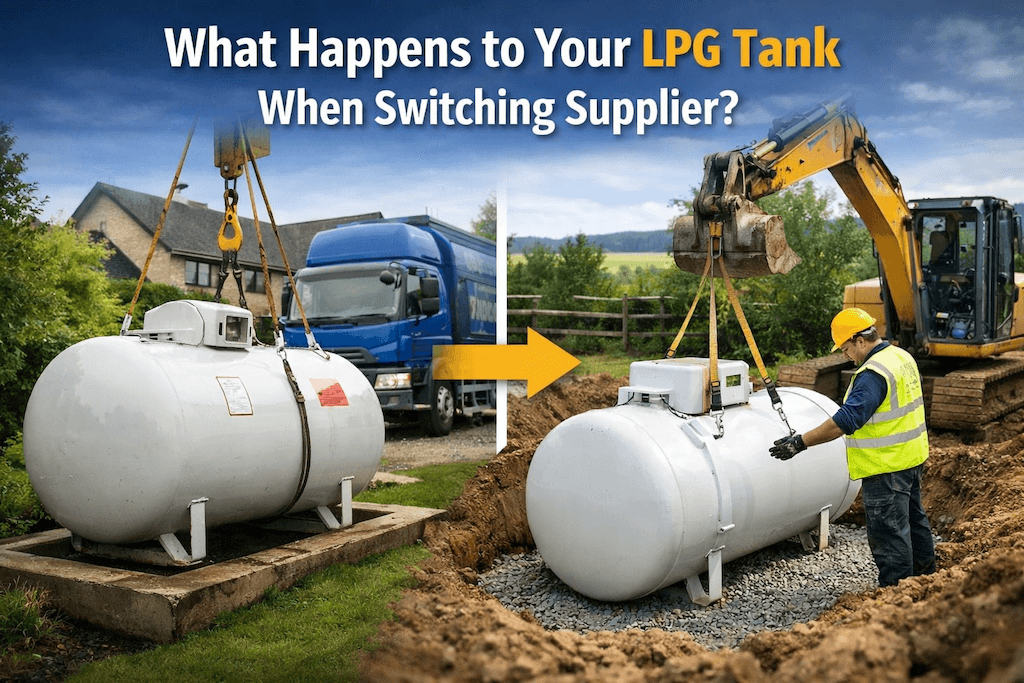
What Happens to Your LPG Tank When You Switch Supplier?
If you are thinking about changing supplier, one of the most common questions is what happens to your LPG tank when switching supplier. Many homeowners assume the tank has to be dug up, removed or replaced every time they move to a new LPG company, but that is often not the case.
In many situations, the existing tank stays exactly where it is and the new supplier simply takes over responsibility for it. However, the outcome depends on who owns the tank, whether the incoming supplier is willing to accept it, and whether the installation still meets the required standards.
Understanding how LPG tank transfer works can help you avoid delays, ask the right questions and switch with more confidence.
Supplier-owned vs customer-owned tank
The first thing to establish is who owns the LPG tank. In most domestic bulk LPG setups, the tank is owned by the supplier rather than the homeowner. This means the tank forms part of the supply arrangement, and responsibility for maintenance, inspection and ongoing safety normally sits with the supplier.
If your tank is supplier-owned, switching is usually more straightforward because the existing tank may be transferred to the new supplier as part of the changeover. That means you can often keep the same tank in the same position, with less disruption to your property.
Some homeowners do own their own LPG tank, but this is less common. If the tank is customer-owned, the new supplier may still agree to supply it, but they may want to inspect it first or impose certain conditions before taking on deliveries. In some cases, an incoming supplier may prefer not to use a privately owned tank at all.
Before you agree to switch, always ask these questions:
- Is the tank owned by me or by the current supplier?
- Is the service pipework included in the arrangement?
- Will the incoming supplier accept the existing tank?
- Will any inspection or remedial work be needed first?
What happens during a tank transfer
Where the current tank is suitable and the new supplier is happy to take it on, the usual process is a tank transfer. This means the ownership and responsibility for the tank pass from the outgoing supplier to the incoming supplier, while the physical tank stays in place.
For the homeowner, this is often the simplest outcome. There is usually less disruption, no need for excavation if you have an underground tank, and less risk of delays compared with a full removal and replacement process.
During a typical tank transfer, the following steps usually happen:
- You agree terms with a new LPG supplier.
- The new supplier contacts the existing supplier to arrange the changeover.
- The tank and associated equipment are reviewed as part of the transfer process.
- Responsibility for future supply, maintenance and safety checks moves to the incoming supplier.
From the homeowner’s point of view, the biggest advantage is convenience. If the existing installation is acceptable, you may be able to switch supplier without any major physical changes to the tank itself.
When a tank may need replacing
Although many switches can be completed through a tank transfer, there are situations where an LPG tank replacement may be needed instead.
This may happen if:
- the incoming supplier does not want to take ownership of the existing tank
- the tank is older and no longer suitable for continued use
- the installation does not meet current siting or safety expectations
- the supplier wants to install its own equipment as part of the new contract
- the service pipework or surrounding setup needs upgrading
If a replacement is required, the old supplier would usually remove its tank and the new supplier would arrange for a new one to be installed. This can take longer than a simple transfer, especially if groundwork, access issues or scheduling are involved.
For homes with underground tanks, replacement can be more involved than for above-ground tanks, so it is worth asking early whether the incoming supplier expects a straight transfer or a full replacement.
What homeowners should check before agreeing a switch
Before committing to a new LPG contract, it is worth checking more than just the price per litre. A lower rate may look attractive, but you also need to understand exactly what is happening with the tank and whether any extra work could affect timings or costs.
Here are the key points to check before you go ahead:
- Tank ownership: confirm whether the current tank is supplier-owned or customer-owned.
- Transfer or replacement: ask whether the new supplier expects to transfer the tank or replace it.
- Timescales: find out whether the switch is likely to be routine or whether tank works could slow things down.
- Access and siting: make sure there are no obvious issues with access for inspection, delivery or replacement if required.
- Contract terms: check the full offer, including tank rental, standing charges, contract length and any conditions attached to the switch.
- Existing installation: ask whether the incoming supplier wants photographs or a site check before confirming the offer.
It is also sensible to keep a copy of your current agreement and any recent supplier correspondence. That makes it easier to confirm ownership, understand your current position and avoid confusion during the switching process.
Why tank questions matter when comparing LPG suppliers
When comparing quotes, many homeowners focus only on the headline price. In reality, the tank side of the process can make a big difference to how smooth the switch will be.
If the tank can be transferred, the process is often simpler and less disruptive. If the tank needs to be replaced, you may need to allow more time and ask more questions about installation, access and responsibility. Either way, understanding the position upfront helps you compare suppliers properly rather than choosing on price alone.
The good news is that for many homes, switching supplier does not mean starting again from scratch. With the right checks in place, changing supplier can be far more straightforward than many people expect.
Get help comparing LPG quotes
If you are looking into switching and want to compare local options, the best starting point is to check what suppliers are offering in your area and understand how the tank side of the process is likely to be handled.
Use our LPG quote tool to compare your local options and see whether you could make a saving.